

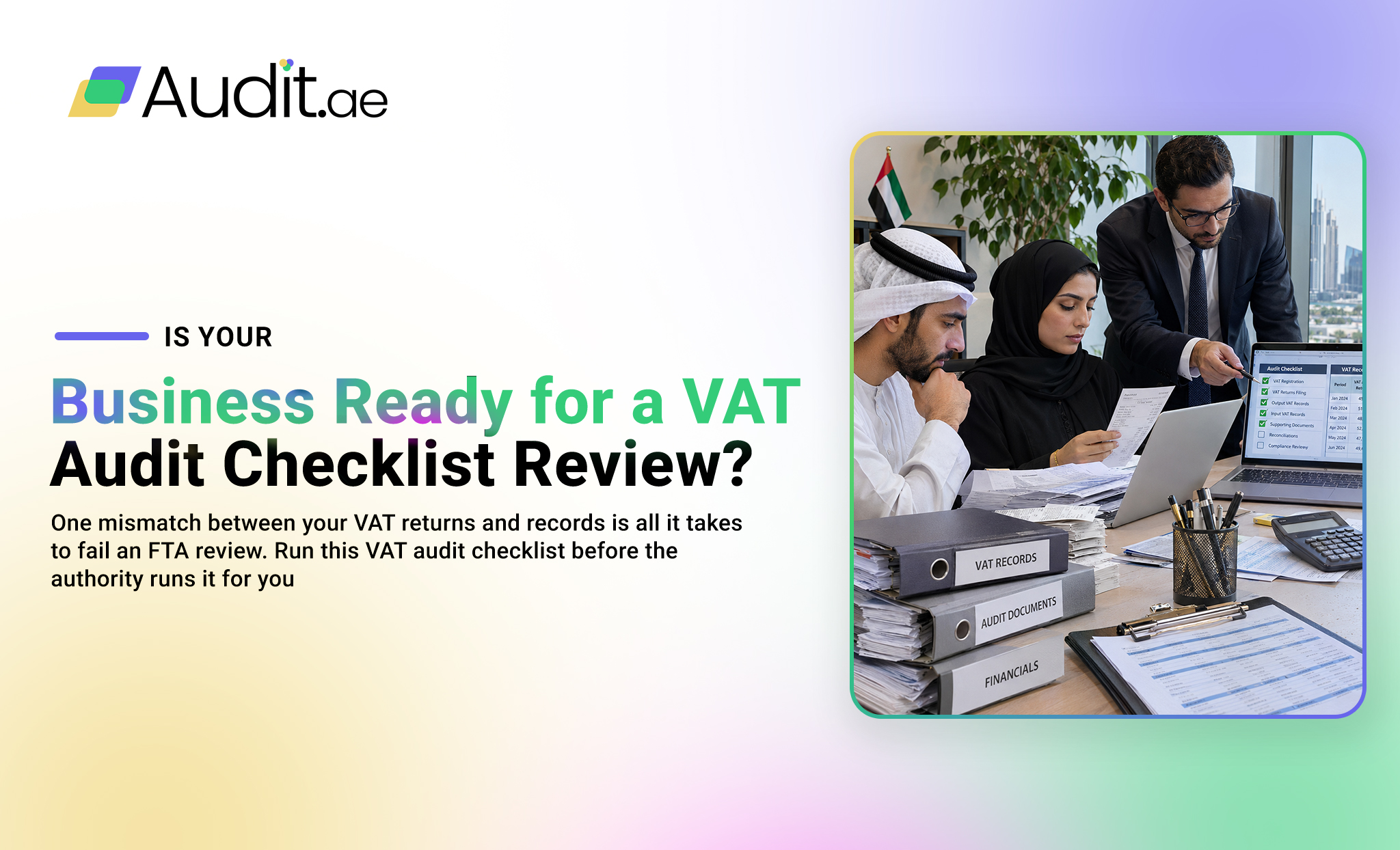
The FTA does not announce a VAT review far in advance. We see the result of that at audit.ae. A business gets the notice then scrambles to find tax invoices and reconcile returns it filed months ago. A VAT audit checklist exists for exactly this moment. It turns a stressful FTA review into a routine one, because the work was already done. This guide gives you a clear checklist to prepare. What the FTA asks for. How to get ready in advance. And the common errors that trigger penalties.
What Is a VAT Audit and What Does the FTA Check?
A VAT audit in UAE is the Federal Tax Authority confirming that the VAT you reported matches your actual business records. The auditor compares your filed returns against your invoices, your books and your import and export records. The FTA is really testing one thing. Whether your output tax and input tax were calculated and reported correctly.
They look at whether your tax invoices are valid whether input tax was claimed correctly, whether zero-rated and exempt supplies were treated properly and whether your returns reconcile to your accounting records. A VAT audit in UAE rarely fails over a single honest mistake. It fails when records are missing or numbers do not tie together.
What Documents Does the FTA Request During a VAT Audit?
The FTA works from evidence, so a VAT audit checklist UAE starts with documents. Having these ready in one place is half the battle.
The FTA typically requests:
- Filed VAT returns for the period under review
- Valid tax invoices for sales and purchases
- Credit and debit notes
- Import and export documentation and customs records
- Bank statements and accounting records
- Your general ledger and VAT account reconciliation
- Records of zero-rated and exempt supplies
- Contracts supporting major transactions
The exact request can vary with your activity. A trading company faces questions on customs and import VAT. A services firm faces questions on place of supply. Preparing whichever set applies to you is the core of a strong VAT audit checklist in UAE.
How Can a Business Prepare for a VAT Audit in Advance?
Preparation is simply doing the audit’s work before the auditor arrives. A business that reconciles as it goes is never caught out.
The steps that matter most:
- Reconcile every VAT return to your accounting records each quarter
- Check that all tax invoices meet FTA format requirements
- Confirm input tax was only claimed where it is recoverable
- Keep import export and customs records matched to your returns
- Store records for at least the required retention period
- Run a self-review before any notice ever arrives
This is where a VAT audit checklist UAE overlaps with a wider audit preparation checklist in UAE. The same discipline that readies you for a financial audit readies you for a tax one. Clean records serve both. In our experience the businesses that pass a VAT review cleanly are the ones that treated preparation as a quarterly habit not a response to a notice.
What Are Common VAT Errors That Trigger Penalties?
Most penalties come from a short list of recurring mistakes. Knowing them lets you check for them in advance.
- Claiming input tax on expenses that are blocked or not recoverable
- Invoices that do not meet the FTA’s tax invoice format
- Treating standard-rated supplies as zero-rated or exempt by mistake
- Returns that do not reconcile with the accounting records
- Missing or incomplete records for the retention period
- Errors in the reverse charge on imports
Each of these is avoidable with a review. The reverse charge and input tax recovery are where businesses slip most often. A VAT audit in UAE tends to land on exactly these points so they belong at the top of your checklist. This is also where audit.ae adds value running a pre-audit review so these errors surface on your desk rather than in the FTA’s findings.
How Do You Build an Audit Checklist That Works?
A checklist only helps if it reflects your real business. Building one is straightforward once you know the logic. Start with the documents the FTA requests and list them. Add a reconciliation step for every VAT return. Add a check on invoice validity and input tax recovery.
Add the error list above as a final sweep. Then set a schedule ideally quarterly so the checklist runs through the year rather than once. A good audit preparation checklist UAE is not a one-off form. It is a routine that keeps you ready at any moment. The businesses that never fear an FTA notice are simply the ones running this quietly in the background.
Conclusion
A VAT audit checklist in UAE comes down to readiness. Keep the documents the FTA requests in order. Reconcile every return to your records. And sweep for the common errors before the authority finds them. Do this throughout the year and a VAT audit in UAE becomes routine rather than a crisis.
The businesses that stay calm under an FTA review are the ones that prepared before the notice arrived. If you want your records kept review-ready and a proper audit preparation checklist UAE running in the background. Visit our website we can handle the preparation so a VAT review is never a scramble.
Tip: reconcile each VAT return to your books the same quarter you file it not at audit time. Almost every failed VAT review traces back to returns that were never checked against the records after filing.
Frequently Asked Questions
During a VAT audit, the FTA may request filed VAT returns, valid tax invoices for sales and purchases, credit and debit notes, import and export records, bank statements, and general ledger records. Businesses should also maintain supporting documents for zero-rated and exempt supplies.
Reconcile every VAT return with your accounting records each quarter, check tax invoice details, verify input tax eligibility, and maintain properly organised supporting documents. Conduct regular internal reviews to identify and correct errors before receiving an FTA audit notice.
Common VAT errors include claiming blocked input tax, issuing invalid tax invoices, incorrectly treating zero-rated or exempt supplies, submitting returns that do not reconcile with financial records, and making mistakes in reverse charge calculations on imports.
Ideally, you should run your VAT audit checklist every quarter before filing your VAT return. Regular quarterly reviews help identify discrepancies early, maintain accurate records, and keep your business prepared for an FTA audit at any time.


