

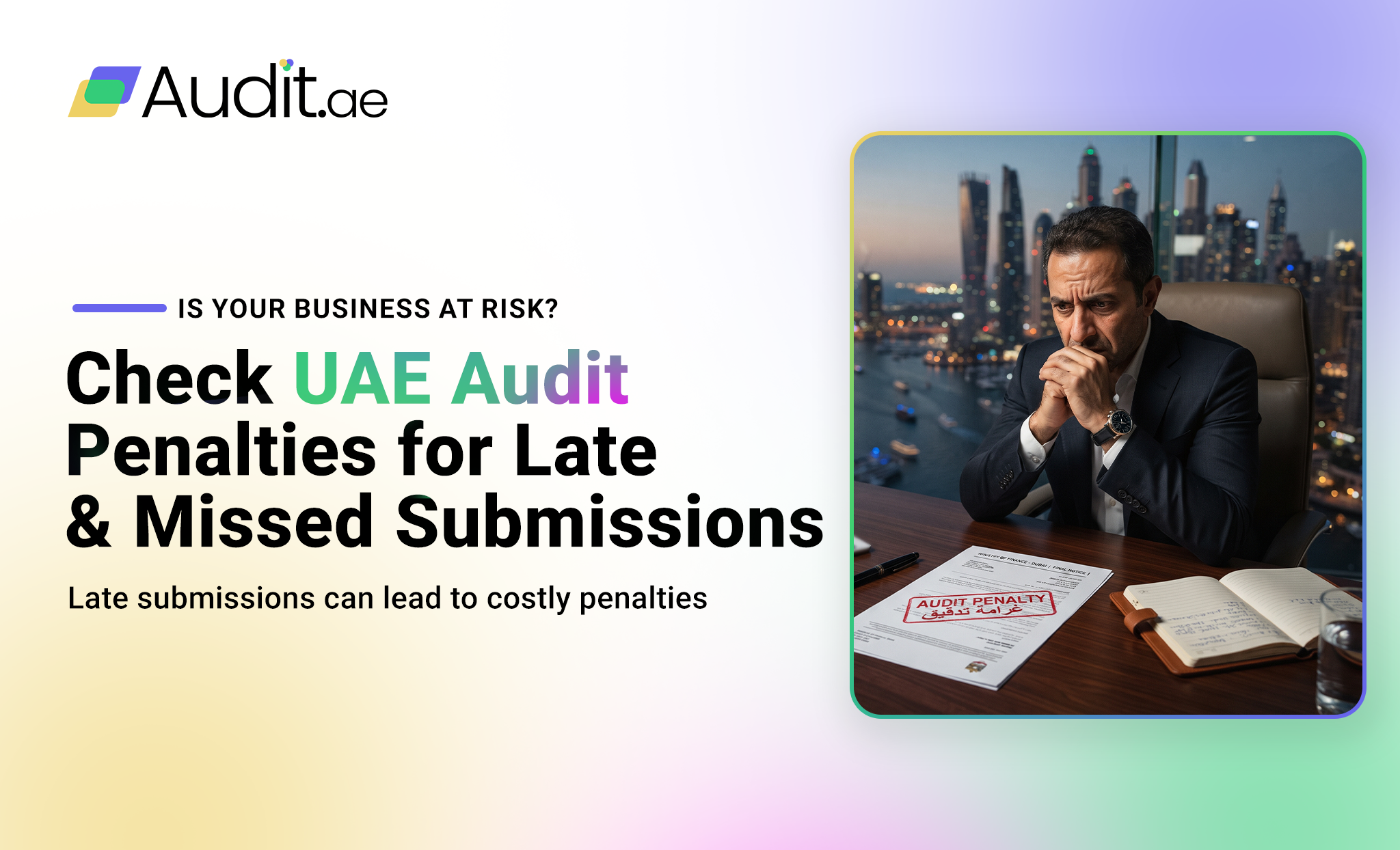
Many businesses found themselves in an uncomfortable situation once the corporate tax came into existence under Federal Decree-Law No. 47 of 2022 that audited financial statements for everyone. The new law has made it compulsory for companies with revenue over AED 50 million and qualifying free zone persons to submit audited financial statements annually.
This guide explains the UAE audit penalties that are applicable if businesses file or do not file audits and the larger UAE compliance penalties associated with poor records.
What are UAE Compliance Penalties and Why does it Matters?
An audit penalty is the financial and administrative effect faced by businesses that don’t submit, prepare or keep audited financial statements and other filings timely.
The Corporate Tax regime and the need for audited financial statements for certain entities were introduced by Federal Decree-Law No. 47 of 2022 on Taxation of Corporations and Businesses. Federal Decree-Law No. 28 of 2022 on Tax Procedures sets out record-keeping obligations and gives the Federal Tax Authority (FTA) the power to penalise non-compliance.
The amounts of the administrative penalties to be applied in the case of corporate tax and VAT violations are prescribed by Cabinet Decisions. Also some free zone authorities can get penalties if the companies do not give proper audited financial statements as a requirement for their licence.
A company may be completely compliant with its free zone authority but may still be subject to FTA penalties for not keeping proper records, and vice versa. Knowing what duties apply to your business entity is the first key step to avoid fines and it’s a question answered daily by the team at audit.ae for businesses in the UAE.
Who Is Required to Submit Audited Financial Statements in the UAE?
The following organizations are required to submit Audited Financial Statements:
Not all UAE businesses are required to have a statutory audit, this is why many of them are not sure whether the penalties are applicable or not. According to the Corporate Tax Law, Ministerial Decision No. 82/2023, two types of Taxable Persons are required to prepare and keep audited financial statements.
- Companies whose turnover was more than AED 50 million in the tax year in question.
- Qualifying Free Zone Persons
Most free zones require an annual audit, in addition to the federal requirement. Most free zones including DMCC, JAFZA, DAFZA, DIFC and others demand that companies submit the financial statements to the authority within a specific period after the end of the financial year usually within three to six months.
Under Federal Decree-Law No. 32 of 2021 on Commercial Companies, mainland companies with the corporate form of an LLC must also undergo annual auditing of their accounts even if they are not subject to submission to a regulator.
What Happens If You Miss an Audit or Filing Deadline?
The consequences depend on which obligation was missed. The table below summarises the key penalties connected to late or missed audit-related submissions under the current UAE framework.
| Violation | Penalty | Legal Basis |
| Failure to keep required records and books (first violation) | AED 10,000 | Cabinet Decision No. 75 of 2023 |
| Repeated failure to keep records within 24 months | AED 20,000 | Cabinet Decision No. 75 of 2023 |
| Late Corporate Tax return filing | AED 500 per month (first 12 months), AED 1,000 per month thereafter | Cabinet Decision No. 75 of 2023 |
| Late Corporate Tax registration | AED 10,000 | Cabinet Decision No. 10 of 2024 |
| Late VAT return submission | AED 1,000 (first offence), AED 2,000 (repeat within 24 months) | Cabinet Decision No. 49 of 2021 |
| Late submission of audited financial statements to a free zone authority | Varies by free zone; fixed fines plus licence renewal restrictions | Individual free zone regulations |
What are the differences in the penalties for a free zone audit?
The audit is not just a tax procedure for free zone companies, it is a requirement imposed by free zone authorities as a condition of operating a business annually. Changes the character of the penalty.
What does DMCC need?
The member companies must submit audited financial statements via the DMCC portal within 180 days of the end of the financial year. Fines may be incurred if companies do not submit on time and importantly companies may be unable to renew their trade licence until audited accounts are submitted. The fine is much less serious to a trading business than a frozen licence.
What About JAFZA and Other Major Free Zones?
JAFZA also mandates the submission of audited financial statements in a prescribed time frame after year-end, and failure to do so will impact on the renewal of the licence. There is a specific regulatory framework for DIFC entities with different filing deadlines depending on entity type and the financial services companies have extra DFSA reporting obligations.
Throughout all of them it’s the same pattern: the visible cost is the direct fine. The true cost of a blocked renewal, suspended portal account or a lost Qualifying Free Zone Person status comes in the operational cost.
How Can Your Business Avoid UAE Audit Penalties?
- Confirm your obligations. Determine whether or not you are in the AED 50 million audit threshold range, are a Qualifying Free Zone Person, or are running a free zone that requires audit submission.
- Map every deadline. Record your financial year end date, your free zone submission window and your Corporate Tax return deadline, which is 9 months after your financial year end date.
- Select your auditor in advance. The months immediately following the common year-end are a busy time of year for auditors in the UAE. The most common reason for late submission is that it was not submitted in a timely manner.
- Close the books on a monthly basis. The clean and up-to-date bookkeeping cuts down on the time it takes for audits significantly and avoids records being reconstructed at the last minute.
- Keep documentation audit-ready. Agreements, contracts, invoices and bank statements should be kept in a way that they are organised as transactions are made, not collected afterwards.
- Check before you use. The amounts and deadlines for penalties are altered in line with new Cabinet Decisions and free zone circulars, so it is important to double-check the current figures yearly.
Conclusion
Large corporations are no longer the only victims of UAE audit penalties. The Corporate Tax audit requirements under Federal Decree-Law No. 47 of 2022, the record-keeping requirements under Federal Decree-Law No. 28 of 2022 and the requirement for submission by the individual free zones,
The fortunate thing is that with careful planning and proper records, all of these compliance fines for UAE can be prevented. When you’re not sure which audit obligations are relevant to your entity when your 2026 audit deadline is approaching or when you’re not sure if your records would pass an audit conducted by an FTA the audit and compliance specialists at audit.ae We will evaluate your situation and can get your submissions on track before audit deadlines become penalties.
Contact us for a review and check your eligibility
Frequently Asked Questions
Failure to submit an audit on time may result in UAE audit penalties, regulatory action, or delays in licence-related services depending on the authority. First-time offenders can face fines of up to AED 10,000, while subsequent offenders may be fined up to AED 50,000 within 24 months.
Cabinet Decision No. 129 of 2025 introduces a more streamlined and proportionate penalty regime for VAT, Excise Tax, and Tax Procedures offences. It replaces the current late payment system with a 14% annual rate, charged and paid monthly.
Yes. Making a Voluntary Disclosure as soon as possible can help businesses correct errors before or during an FTA review and reduce penalties where applicable under UAE tax laws. Acting early also demonstrates a proactive approach to tax compliance and helps minimise further compliance risks.
No. Not every business in the UAE is required to submit audited financial statements. The requirement depends on the type of business, licensing authority, and applicable Free Zone regulations.


