

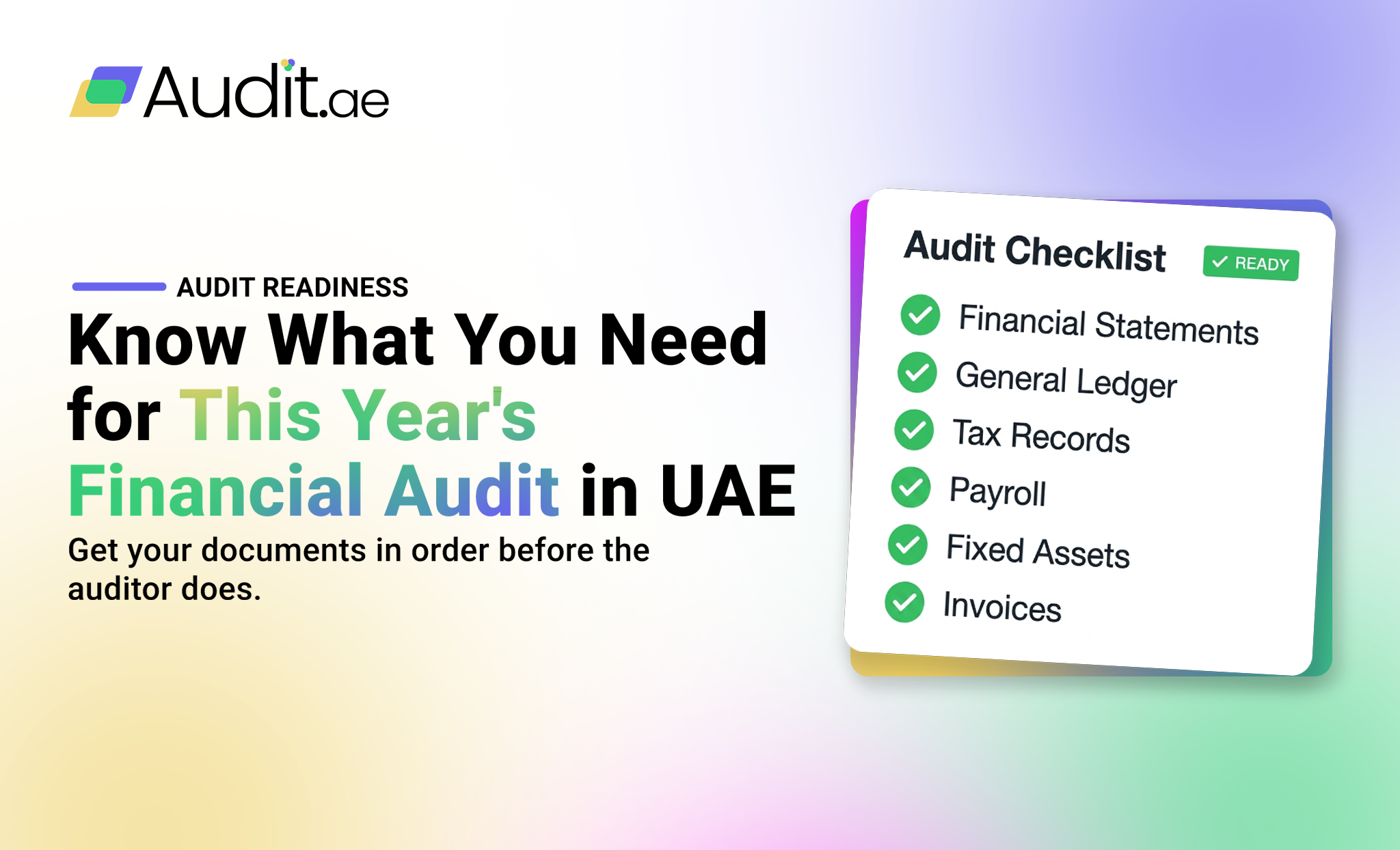
Not every business in the UAE needs a financial audit. Whether your company needs one depends on your revenue, your tax status, your free zone authority, and sometimes your shareholders or lenders. This guide explains exactly who is required to audit, how the audit process works from start to finish, and what a financial audit typically costs in 2026.
At audit.ae, we help mainland and free zone businesses in the UAE understand their audit obligations and prepare financial statements that hold up under review. Here is what you actually need to know.
What Is a Financial Audit and Why Does It Matter?
A financial audit is an independent review of a company’s financial statements to confirm they fairly represent the business’s financial position and performance. An external, independent auditor examines accounting records, transactions, internal controls, and supporting documents, then issues a formal opinion on whether the statements can be relied on.
Most audits are not done purely to satisfy a regulator. Banks, investors, and shareholders all rely on audited numbers before they commit money, and that is often the real reason a company gets audited even when the law does not force it.
A financial audit in the UAE typically helps a business:
- Show lenders and investors that its financial reporting is reliable
- Meet license renewal or regulatory documentation requirements
- Catch reporting errors or weak internal controls before they become bigger problems
- Strengthen overall governance and financial accountability
- Support funding rounds, due diligence, or acquisition discussions
Is a Financial Audit Mandatory in the UAE?
A financial audit is mandatory for some UAE businesses and optional for others. There is no single rule that applies to every company. Whether an audit is required depends on your revenue, your Corporate Tax status, your free zone authority’s own rules, and sometimes the expectations of your shareholders or lenders.
Under Corporate Tax law, Ministerial Decision No. 84 of 2025 sets out exactly which taxable persons must keep audited financial statements. It took effect for tax periods starting on or after 1 January 2025 and replaced the older Ministerial Decision No. 82 of 2023.
Who must keep audited financial statements under UAE Corporate Tax law
| Business Type | Audit Requirement |
| Standalone taxable person with revenue over AED 50 million | Audited financial statements are required. |
| Qualifying Free Zone Person (QFZP), any revenue level | Audited financial statements are required. Skipping the audit means the FTA taxes the business at the standard 9 percent rate instead of the 0 percent qualifying rate. |
| Tax Group (any member, any size) | All tax groups must prepare audited special purpose financial statements. The old AED 50 million threshold for tax groups no longer applies. |
| Other UAE businesses under AED 50 million, not a QFZP | An audit may still be required by the company’s free zone authority, shareholders, lenders, or specific licensing rules, even though Corporate Tax law does not force it. |
If your business is a Qualifying Free Zone Person, the audit is not just a formality. Without it, the FTA cannot apply the 0 percent qualifying rate, and your income gets taxed at the standard 9 percent rate instead.
If you are not in any of these categories, Corporate Tax law itself does not force an audit. But your free zone authority might still require one as a condition of your license renewal, and the rules vary from one free zone to another, so it is worth checking your specific authority’s requirements rather than assuming you are exempt.
Do UAE Businesses Have to Follow IFRS for Their Audit?
Most financial audits in the UAE are based on financial statements prepared under International Financial Reporting Standards, known as IFRS. For Corporate Tax purposes specifically, Ministerial Decision No. 114 of 2023 allows two accepted standards: full IFRS, or IFRS for SMEs.
IFRS for SMEs is only available to a taxable person whose revenue does not exceed AED 50 million in a tax period. Above that threshold, full IFRS applies. So IFRS is not a single blanket rule that applies the same way to every company. It is full IFRS above the revenue threshold, and a choice between full IFRS and IFRS for SMEs below it.
Documents auditors typically ask for
- Financial statements and trial balance
- General ledger and chart of accounts
- Bank statements and bank reconciliations
- Fixed asset register
- Accounts receivable and accounts payable records
- VAT documentation and Corporate Tax records
- Payroll records
- Contracts, agreements, and supporting invoices or receipts
How Does the Financial Audit Process Work in the UAE?
A typical UAE financial audit runs through four stages: planning, testing, evaluation, and the final audit opinion. Most straightforward SME audits take a few weeks from the time records are handed over to the time the signed report is issued, though this depends heavily on how ready your books are.
1. Planning and risk assessment
The auditor learns the business, identifies where the biggest risks sit, and decides which transactions, balances, and processes need closer attention. This stage is faster when the company already has clean, organized records.
2. Testing and verification
The auditor checks supporting documents, reviews accounting records, and tests a sample of transactions across areas such as revenue, costs, inventory, fixed assets, and payroll. This is usually the longest stage, and it is also where poor record keeping adds the most time and cost.
3. Evaluation of the financial statements
Once testing is complete, the auditor assesses whether the financial statements as a whole have been prepared correctly under the applicable reporting framework, typically IFRS or IFRS for SMEs.
4. The audit opinion
The auditor issues a formal report containing their opinion on the financial statements. This report is what gets submitted to the FTA, a free zone authority, a bank, or an investor, depending on why the audit was needed.
One rule that catches business owners off guard
Your auditor cannot also be the firm that does your bookkeeping. UAE auditor independence rules mean the firm signing your audit opinion cannot have prepared your day to day accounts or financial statements. If the same firm does both, the audit opinion loses credibility, and some regulators will not accept it. Many businesses use one firm for bookkeeping and a separate, independent firm for the audit itself.
How Much Does a Financial Audit Cost in the UAE in 2026?
There is no fixed fee for a UAE financial audit. Cost depends mainly on company size, transaction volume, industry, and how clean your accounting records already are going into the audit. A company with messy or incomplete books should expect to pay more, because the auditor has to spend extra time reconstructing and verifying information that should already be in order.
| Company Profile | Typical Fee Range (AED) | What Usually Drives This |
| Small company or startup | 5,000 to 12,000 | Simple revenue, few transactions, clean books |
| SME with moderate complexity | 12,000 to 25,000 | Multiple revenue streams, inventory, or several bank accounts |
| Medium to large business | 25,000 to 50,000 | Multi entity structure, higher transaction volume, prior audit issues |
| Large enterprise or group structure | 50,000 and above | Consolidation, multiple jurisdictions, custom scope |
What is usually included, and what usually costs extra
A standard audit fee typically covers planning, testing, the financial statement review, and the signed audit opinion. It usually does not cover VAT audit support, Corporate Tax return preparation, Economic Substance Regulations filing, or Ultimate Beneficial Owner verification. Ask your auditor to confirm exactly what is in scope before you agree on a fee, so there are no surprises later.
The fastest way to lower your audit cost
Keep your bookkeeping current throughout the year instead of catching up right before the audit. Auditors charge more when they have to chase missing invoices, reconcile unexplained bank transactions, or rebuild a fixed asset register from scratch. Businesses with organized, up to date records consistently pay less for the same audit scope.
Conclusion
A financial audit in the UAE is not just a box to tick. For Qualifying Free Zone Persons it decides whether you keep the 0 percent tax rate, for tax groups it is now mandatory regardless of size, and for everyone else it remains one of the clearest ways to show lenders, investors, and regulators that your numbers can be trusted.
Knowing which category your business falls into, and keeping your records audit ready throughout the year, is what actually controls both your compliance position and your audit cost.
Reach out to audit.ae if you want help working out your audit obligations, preparing IFRS compliant financial statements, or getting your business ready for this year’s audit.
Frequently Asked Questions
Everything you need to know — answered.
It depends on the business. A financial audit is mandatory under UAE Corporate Tax law for any standalone taxable person with revenue over AED 50 million, for every Qualifying Free Zone Person regardless of revenue, and for all tax groups. Businesses outside these categories may still need an audit if their free zone authority, shareholders, or lenders require one.
IFRS is the standard most UAE businesses use for financial reporting, and it is one of two accepted standards for Corporate Tax purposes. Companies with revenue up to AED 50 million in a tax period can choose IFRS for SMEs instead of full IFRS. Above that threshold, full IFRS applies. So IFRS is not a single fixed rule that looks the same for every company. It depends on revenue size.
The business loses access to the 0 percent qualifying Corporate Tax rate, and the FTA taxes its income at the standard 9 percent rate instead. For most QFZPs this makes the audit one of the most financially significant compliance steps in their entire tax year.
Most small companies pay between AED 5,000 and 12,000 AED. SMEs with moderate complexity typically pay between AED 12,000 and 25,000. Medium to large businesses usually fall between AED 25,000 and 50,000, and large enterprises or group structures are generally quoted on a custom basis. The exact fee depends on company size, transaction volume, and how organized your records are.
No. UAE auditor independence rules do not allow the same firm to both prepare your bookkeeping or financial statements and sign the audit opinion on those same statements. Most businesses keep these as two separate engagements with two different firms.
A typical monthly audit readiness checklist covers bookkeeping close, bank reconciliation, VAT review, document filing, revenue and expense checks, payroll review, receivables and payables aging, inventory review, fixed asset updates, and management sign off on any unusual transactions.
Contact audit.ae for a straightforward answer on whether your business needs an audit this year, and what it will likely cost.


