

The UAE has been making significant efforts to implement its tax laws and regulations. It is also making advances in having proper financial records, as the supporting documents are compulsory for business compliance. As a startup, an SME, or an established organisation, knowing what may raise a red flag for a VAT Audit in UAE could help you lower the possibility of not meeting the requirements during a VAT Audit conducted by the FTA.
In this guide we will discuss the common audit triggers like what the FTA is looking for. How to prepare for an audit and how audit.ae help businesses stay prepared for audit all year long.
What Is a VAT Audit in UAE and Why Does It Matter?
First let’s discuss the VAT audit and its authority. The Federal Tax Authority (FTA) conducts a VAT Audit to ensure that a business is calculating, reporting and paying VAT in accordance with the UAE tax laws. Also keep in mind that a tax audit is different from a financial audit. A financial audit examines the accuracy of financial statements while an FTA Tax Audit in UAE examines tax compliance. The authority may ask for VAT returns, accounting records, invoices, customs documents, bank reconciliation statements and other documentation to support the reported VAT in order to verify that the correct VAT is being reported for business transactions.
Keeping up to date books is not just important for VAT compliance but now it also helps businesses in preparing for a Corporate Tax Audit. Good accounting helps minimize compliance issues, financial transparency and allows companies to respond efficiently if the FTA asks for more information.
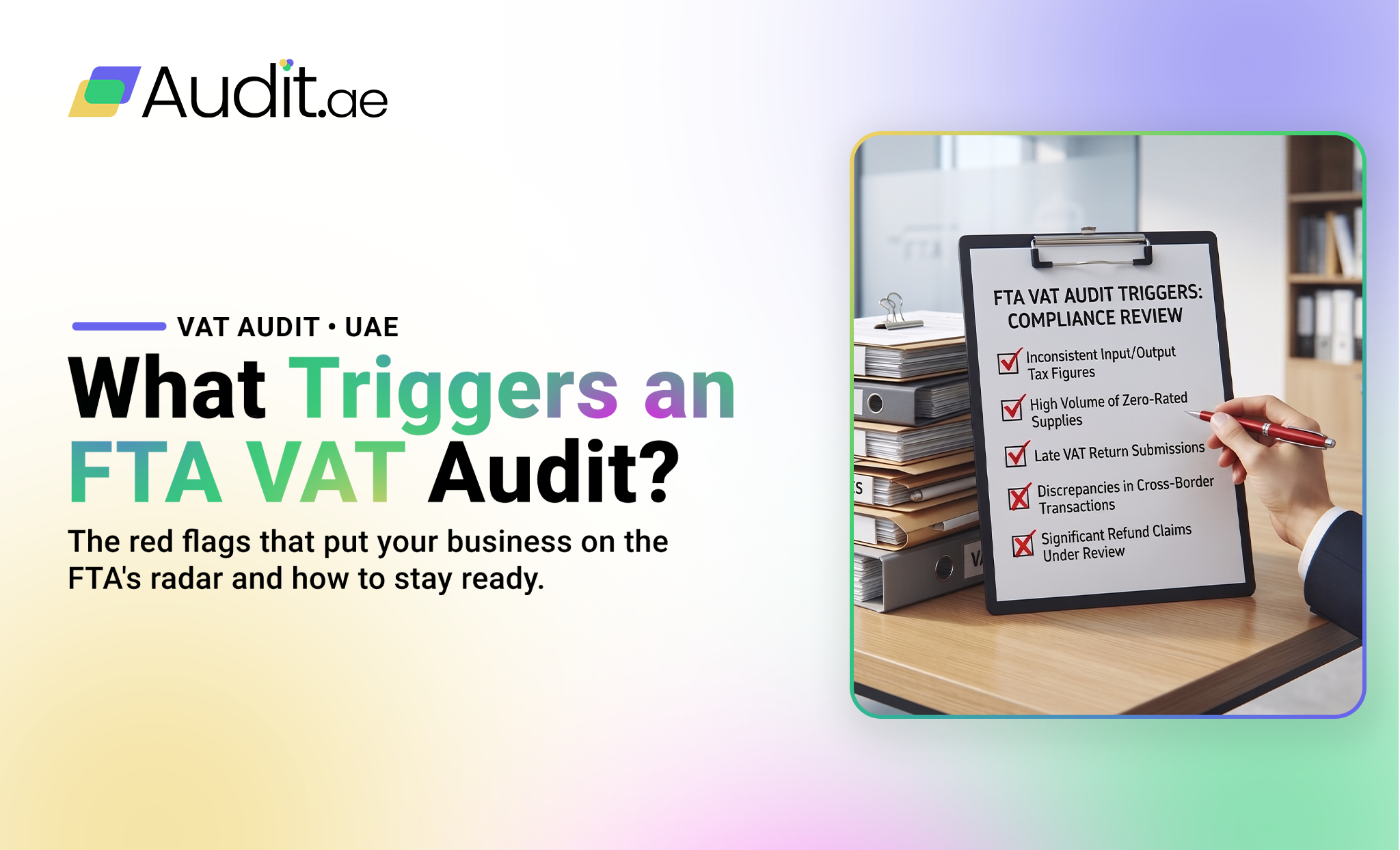
What Might Trigger an FTA Review of Your Business?
The Federal Tax Authority adopts a risk-based approach in its selection of business for review. Although not all audits are due to a compliance concern some factors may make a VAT Audit in UAE more likely.
A wrong or incomplete VAT Return
The most frequently encountered causes of FTA Tax Audit in UAE are mismatches found in the VAT returns and accounting records. Even a mistake that was not intentional may trigger the authority to look for further clarification.
Large VAT Refund Claims
If the business has an unusually high claim for VAT refunds it may request further supporting paperwork. The FTA evaluates these claims to ensure the refund is not fraudulent and is backed by transparent financial records.
Late VAT returns or payments
If VAT returns are filed late or tax is paid late there may be an increased risk of non-compliance. A late filing doesn’t automatically trigger an audit but repetitive delays can cause more attention to be paid to the filing.
Incomplete or Missing Documentation
Businesses must keep full records for each VAT transaction. Failure to keep tax invoices, contracts, import documents or accounting records may make it challenging to prove compliance in a VAT Audit in UAE.
Risk-Based or Random Compliance Reviews
The FTA can routinely review compliance in different industries. Compliance history might also be matched up with businesses, but if it is good they can still be chosen so it is important to be constantly ready for audits for any VAT-registered business.
What Does the FTA Check During a VAT Audit in UAE?
An FTA tax audit in UAE assesses the accuracy of the VAT reported, considering your business activities. An auditor reviews a tax return and its documentation to see if there are inconsistencies or mistakes.
The FTA may review:
- VAT returns are submitted to the FTA.
- Tax Invoices and Credit Notes.
- Records of purchases and sales.
- Financial books and account books.
- Financial statements.
- Bank reconciliations.
- Import/export paperwork.
- VAT adjustment/reimbursement documentation.
How to Prepare for a VAT Audit in UAE
VAT Audit preparation should not be an event that occurs only after an audit notification.The preparation for a VAT Audit in UAE should be a routine process for your business and not follow an audit notice. For businesses that keep good records throughout the year, there is a much better chance involved that they will be able to prove compliance if they are chosen to have a review by the FTA.
A practical Audit Preparation Checklist in UAE includes:
- Making a VAT return before it is sent to compare with accounting records.
- Maintaining complete tax invoices and supporting documentation.
- Ensuring purchase, sales and customs records are kept in order.
- Regularly checking VAT calculations for accuracy.
- Regular self compliance assessment.
- Ensuring accounting records are accurate and up to date.
- Keeping the UAE tax legislation’s prescribed records of VAT.
Companies can enhance their readiness for a VAT Audit with our expert Audit services in UAE, which include compliance reviews, documentation evaluations, accounting assistance and practical guidance specific to UAE tax requirements. Our experts also help businesses in UAE to prepare for an FTA tax audit or a corporate tax audit
Conclusion
It is important to have a VAT Audit in UAE and all VAT-registered businesses should be ready to showcase that they are reporting accurately and have all the necessary documentation. Keeping proper books of accounts and following audit preparation checklists can greatly reduce the compliance risks.
If you’re still not sure if your business is ready then audit.ae can assist you. Our experts offer valuable assistance to various businesses to ensure that they comply with their tax obligations on time and are prepared for VAT audit and corporate tax audit in UAE.
Reach out to us for a free consultation
Frequently Asked Questions
Everything you need to know — answered.
During a VAT Audit, the Federal Tax Authority (FTA) reviews your VAT returns, tax invoices, accounting records, financial statements, purchase and sales transactions, import and export documents, and supporting evidence to verify that your VAT reporting is accurate and compliant with UAE tax laws.
A VAT Audit in the UAE may be triggered by inaccurate or inconsistent VAT returns, large or unusual VAT refund claims, late VAT return filings or tax payments, missing or incomplete supporting documentation, inconsistencies between accounting records and VAT submissions, or risk-based and routine compliance reviews by the FTA.
In many cases, businesses must keep VAT records in the UAE for at least five years from the end of the relevant tax period.
The four common stages of an FTA Tax Audit in the UAE are audit notification, document submission, audit examination, and clarifications and discussions.


