

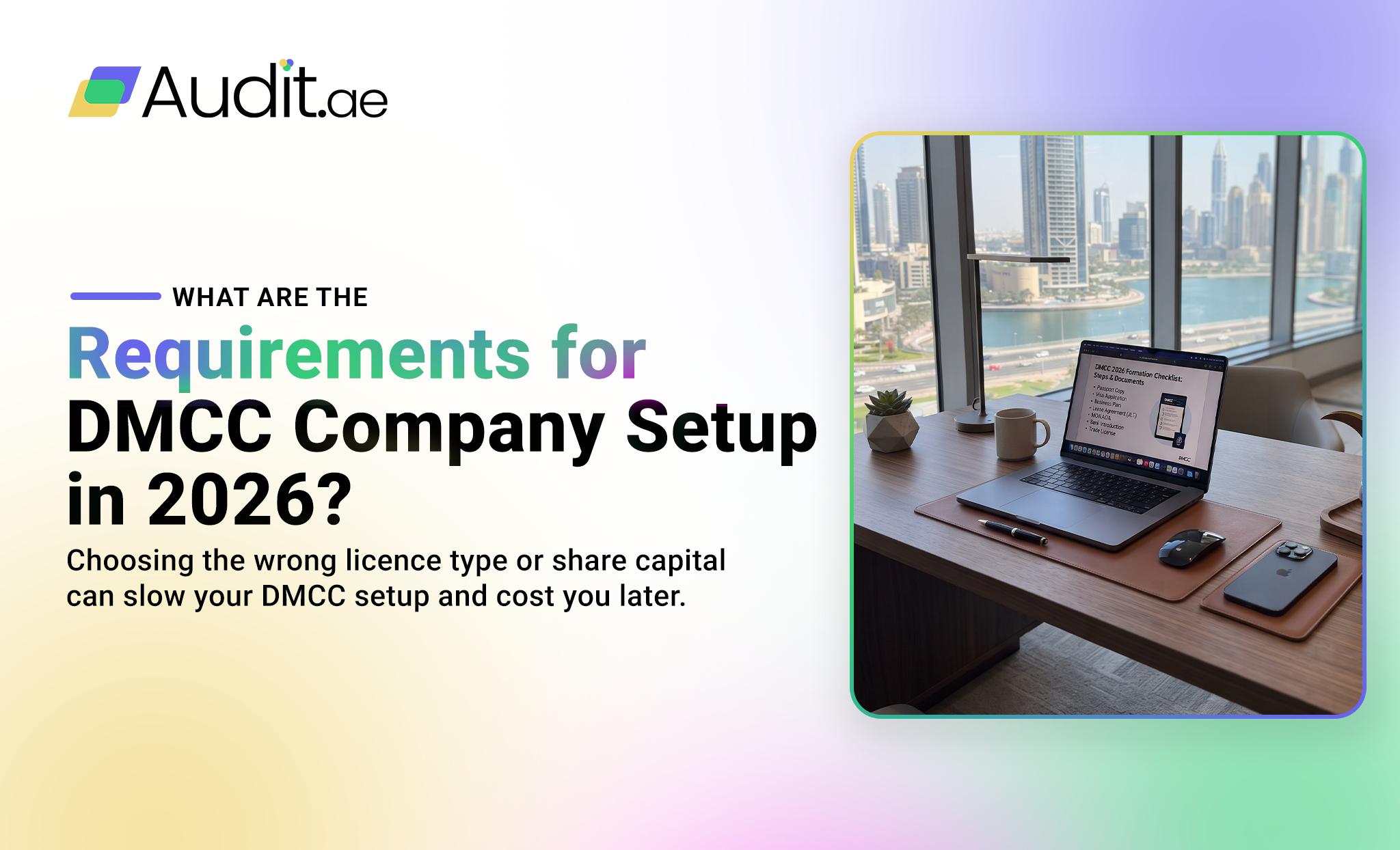
Most people research DMCC expecting a long list of hurdles. The reality is more approachable than the rumours suggest. There is usually no large capital required; you just need a normal setup, which is enough for many businesses. What actually matters is fulfilling a clear set of conditions correctly the first time. At audit.ae we often find that founders delay their setup for months over requirements that were never as heavy as they feared while overlooking the ongoing obligations that genuinely need planning.
This guide lays out the DMCC company setup requirements for 2026 in plain terms. It covers what you need to qualify, whether there is a minimum capital what office solution is enough and the compliance duties that come once your company is live.
What Are the Requirements to Set Up a DMCC Company?
The DMCC company setup requirements are the conditions your business must meet to be licensed inside the free zone. They are clearer than most founders expect and the majority of applicants get them without trouble.
At a high level a DMCC company needs to meet these conditions:
- A permitted business activity
- A compliant company name
- At least one shareholder and one director
- A registered address inside DMCC
- Appropriate share capital
- A complete document set
The anchor among these conditions is your business activity. It decides your licence type, shapes your fees and can trigger extra approvals for regulated work such as financial services or certain commodity trading. Choosing the right activity at the start is what keeps everything else straightforward. Get that right and the rest of the requirements fall into place naturally.
What DMCC Registration Documents Do You Need?
Meeting the conditions is one half of the setup. Proving them is the other. The DMCC registration documents are what confirm your identity, your structure and your eligibility.
A standard set includes:
- Passport copies for every shareholder and director
- Passport-style photographs
- Proof of address for the shareholders
- The completed DMCC application form
- A business plan for certain regulated activities
- Parent company documents for a corporate shareholder, such as the certificate of incorporation and a board resolution
An individual owner needs far less than a corporate one. Where a parent company is the shareholder, its documents usually need attestation and often legal translation, and this is the paperwork that most often slows an application down.
Is There a Minimum Capital Requirement in DMCC?
This is the requirement founders worry about most and usually needlessly. For most standard activities DMCC does not force you to deposit a large fixed sum before you can trade. Share capital is generally declared as part of forming the company rather than locked away in a blocked account. That said the condition depends on your activity. Some regulated or specialised activities do carry specific capital expectations, and the declared capital should be reasonable for the business you are running.
A company claiming a very high capital may be asked to show it. So the honest answer is that most businesses face a modest and manageable capital position rather than a heavy barrier but the exact figure depends on what you do. Because capital rules vary by activity and can change, confirm your specific requirement with DMCC rather than assuming a general number applies to you.
Do I Need a Physical Office or Is a Flexi Desk Enough?
Every company registered in the free zone needs a registered address inside DMCC, but that does not mean you need a full office. For many businesses a flexi desk is enough. A flexi desk is a shared workspace that satisfies the address requirement at a fraction of the cost of a private office. It suits solo founders, consultants and small service companies that do not need dedicated space.
The trade-off is visa capacity. A flexi desk supports only a limited number of visas, so it works while your team is small. As you grow and need more visas or actual workspace you move up to a physical office. The right choice comes down to your headcount and your visa needs. Starting lean on a flexi desk and upgrading later is a common and suitable way.
What Are the DMCC Compliance Requirements After Setup?
Getting licensed is only the beginning. The DMCC compliance requirements that follow are where many founders underestimate the real work and where getting it wrong costs the most.
Once your company is live you take on a set of yearly obligations:
- Renew your trade licence every year
- Keep proper accounting records throughout the year
- Submit audited financial statements to DMCC within the required window
- Register for Corporate Tax, as most DMCC companies must
- Handle VAT if it applies to your activity and turnover
The companies that run into trouble are rarely the ones that failed to set up correctly. They are the ones that treated the setup as the finish line and then let the annual audit and tax deadlines drift. A blocked renewal over a late audit is far more disruptive than anything in the setup stage. This is exactly the part audit.ae is built to handle, keeping your books audit-ready managing your annual audit and filing your Corporate Tax so your compliance never puts your licence at risk.
Conclusion
The requirements for DMCC company setup in 2026 are more manageable than their reputation. You need a permitted activity, a compliant name of at least one shareholder and director, a registered address, sensible capital and a complete document set. There is usually no heavy capital deposit, a flexi desk is enough for many and foreign founders can own everything outright.
The part that deserves real attention is what comes after. Annual renewals, audited accounts and tax filings are not optional, and DMCC enforces them strictly. Meet the setup conditions cleanly and stay on top of the ongoing duties, and DMCC is one of the smoothest places in the world to run a business. If you want your DMCC company set up correctly and kept fully compliant from day one we can guide the requirements and then manage your audit, accounting and tax so your licence stays secure while you grow. contact us for more details.
Frequently Asked Questions
Everything you need to know — answered.
A permitted business activity, a compliant company name, at least one shareholder and director, a registered address inside DMCC, appropriate share capital, and a complete document set. A single person can be both the shareholder and director.
For most standard business activities, there is no large fixed deposit, and the share capital is generally declared rather than locked. However, some regulated activities have specific capital requirements, so it is best to confirm the applicable amount with DMCC.
A flexi desk is suitable for many startups and small businesses, meeting the registered address requirement at a lower cost. It also supports a limited number of visas, with the option to upgrade to a physical office as your business expands.
A DMCC company must renew its trade licence annually, maintain proper accounting records, submit audited financial statements on time, register for Corporate Tax, and comply with VAT requirements if applicable based on its business activity and turnover.


