

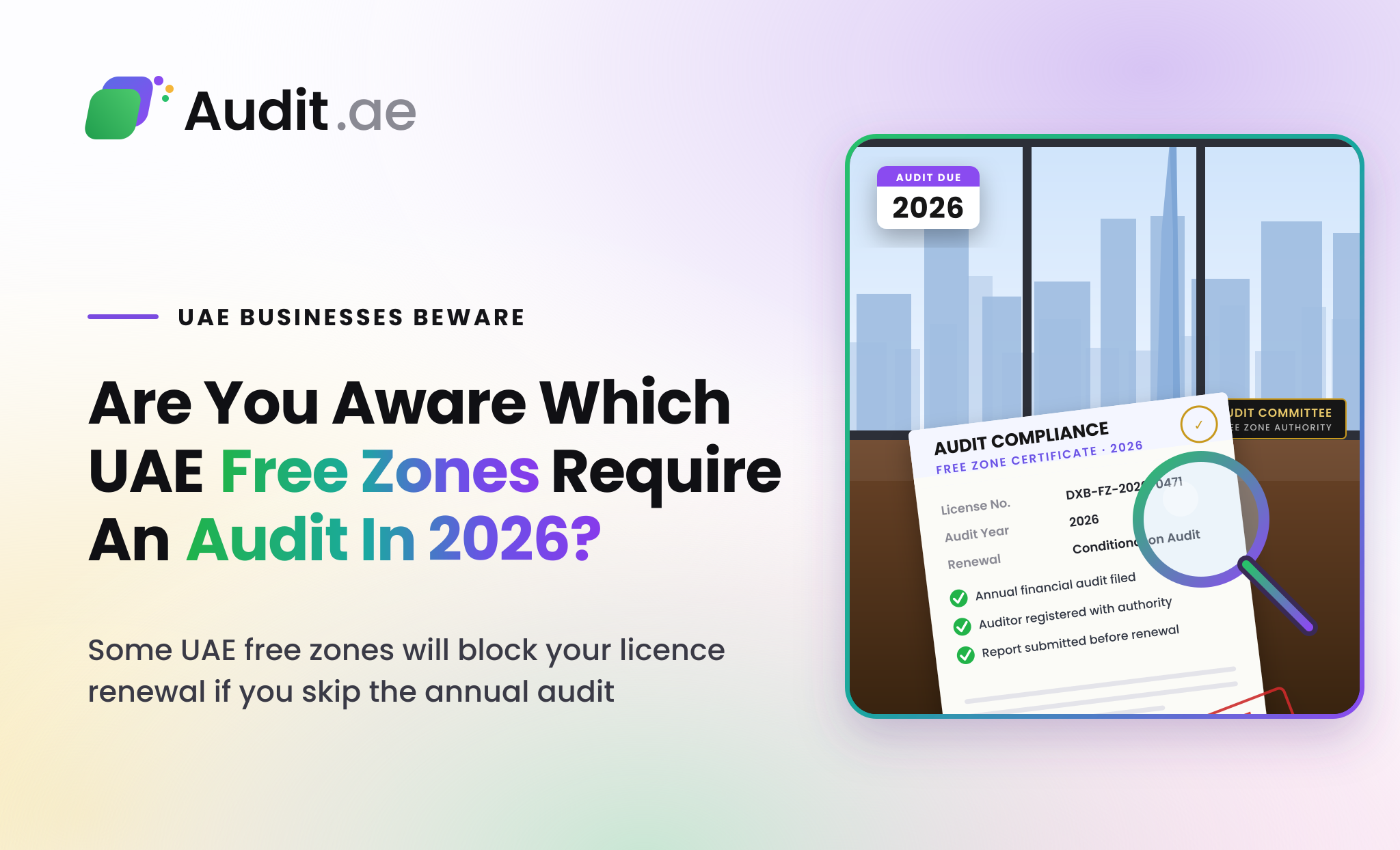
Many free zone owners still believe an audit is optional. In 2026 that belief is expensive. Corporate Tax has changed the picture and several free zones now treat audited financial statements as a hard condition of doing business. Some will not renew your trade license until you file them. Others tie the audit to your 0% tax rate. Either way the cost of assuming you are exempt is far higher than the audit itself.
The problem is that no two free zones work the same way. A rule that applies in DMCC may not apply in the exact same form in RAKEZ. This guide breaks down the free zone audit requirements in the UAE for 2026. It covers who must file how the major free zones compare and what happens if you miss the window.
What Are the Free Zone Audit Requirements in UAE?
The free zone audit requirements in UAE are the rules that decide whether your company must prepare and submit audited financial statements to its free zone authority. These rules do not come from one place. They come from each free zone and now also from the Corporate Tax Law.
There are two layers to understand. The first layer is the free zone licence condition. Many free zones require audited accounts as a term of holding or renewing your licence. The second layer is Corporate Tax. A Qualifying Free Zone Person must have audited financial statements to keep its 0% rate on qualifying income. A business can be caught by one layer or both.
This is why a blanket answer never works. Your obligation depends on which free zone you sit in and whether you claim the 0% rate or the 9% Rate: Applied on taxable income which does not qualify under the Free Zone provisions. Mapping this early is one of the first things the team at audit.ae checks for a free zone client.
Which UAE Free Zones Require an Audit in 2026?
Most of the major free zones now require an audit in some form. The safest assumption in 2026 is that your free zone expects audited accounts unless you have confirmed otherwise in writing.
Free zones broadly fall into three groups. The first group requires audited financial statements to be submitted every year as a licence condition. DMCC and JAFZA sit here. The second group requires you to prepare audited accounts and keep them ready even if annual submission is lighter. The third group historically had softer rules but is tightening fast because Corporate Tax now pushes most Qualifying Free Zone Persons toward an audit anyway.
The takeaway is simple. Even if your free zone does not force you to submit accounts it may still need them. So the real question is not only what your free zone demands. It is also what Corporate Tax demands of you. Meeting both is what full free zone audit requirements in the UAE really mean.
How Do DMCC JAFZA DAFZA and RAKEZ Audit Rules Compare?
The four best-known free zones show how much the detail can vary. The table below gives a plain comparison. Treat it as a guide and confirm your own numbers with the authority since these rules change through circulars.
| Free zone | Audit submission | Approved auditor list | Key point |
| DMCC | Audited accounts submitted through the portal each year within a set window | Yes. Auditor must be approved | Late filing can block license renewal |
| JAFZA | Audited accounts required for license renewal | Yes in most cases | Renewal is the main pressure point |
| DAFZA | Audited financial statements required annually | Yes in most cases | Strict on documentation |
| RAKEZ | Audit increasingly required especially for the 0% rate | Varies by activity | Historically lighter but tightening |
How Do Free Zone Audits Link to External Audit Requirements in UAE?
The external audit requirements in UAE and the free zone rules are really two names for the same obligation in most cases. An external audit is an independent review of your financial statements by an approved auditor from outside your business. That is exactly what a free zone expects you to submit.
For most companies the external audit requirements in UAE are driven by three things. Your free zone licence condition. Your Corporate Tax position if you are a Qualifying Free Zone Person. And your revenue if you cross the threshold that forces audited accounts. A mainland LLC also faces its own audit duty even without a free zone. So the external audit is not a free zone quirk. It is a wider UAE compliance feature that free zones happen to follow strictly.
How Can You Meet Your Free Zone Audit Requirements on Time?
Meeting the free zone audit requirements in UAE is mostly about planning early. The companies that never get fined follow the same simple pattern.
- Confirm whether your free zone requires annual submission or just prepared accounts
- Check whether you also need an audit for the 0% Corporate Tax rate
- Make sure your auditor is on your free zone approved list
- Keep your books clean and current all year rather than at the last minute
- Note your free zone submission date and your Corporate Tax date separately
- File well before the deadline so a rejection still leaves time to fix it
An audit only becomes stressful when it is left late. A business that closes its books monthly and engages an approved auditor early rarely has a problem. Where internal capacity is thin then outsourcing the audit and the filing to a specialist like audit.ae is far cheaper than a blocked licence renewal.
Conclusion
The free zone audit requirements in UAE are no longer something you can guess at. In 2026 most major free zones expect audited financial statements and several will block your licence renewal without them. On top of that Corporate Tax pushes nearly every Qualifying Free Zone Person toward an audit to protect the 0% rate. DMCC JAFZA and DAFZA are strict. RAKEZ and others are catching up fast.
The fix is early planning and an approved auditor. If you are unsure whether your free zone requires an audit or how your 2026 deadlines line up then we can confirm your obligations and manage the audit and submission from start to finish.
Frequently Asked Questions
The free zone audit requirements in UAE are no longer something you can guess at. In 2026 most major free zones expect audited financial statements and several will block your licence renewal without them. On top of that Corporate Tax pushes nearly every Qualifying Free Zone Person toward an audit to protect the 0% rate. DMCC JAFZA and DAFZA are strict. RAKEZ and others are catching up fast.
The fix is early planning and an approved auditor. If you are unsure whether your free zone requires an audit or how your 2026 deadlines line up then we can confirm your obligations and manage the audit and submission from start to finish.
Most major free zones now require an audit. DMCC JAFZA and DAFZA expect audited accounts each year. Others need them for the 0% Corporate Tax rate even if submission rules are lighter.
DMCC and JAFZA tie the audit to licence renewal and use approved auditor lists. DAFZA requires annual audited accounts. RAKEZ was lighter historically but is tightening under Corporate Tax.
Penalties vary by free zone and often include a fine plus a block on licence renewal. A Qualifying Free Zone Person can also lose its 0% rate. Always confirm the current amount with your authority.
Yes in most cases. Free zones like DMCC keep an approved auditor list and can reject a report from a firm that is not on it. Confirm your auditor is approved before you engage them.


